News
WAL – Wilhelmshavener Connection pipeline
In March 2022, Mannesmann Grossrohr GmbH (MGR) was awarded a contract by the transmission system operator Open Grid Europe GmbH (OGE) to supply the pipeline tubes, around 30 km for the connecting pipeline of the Wilhelmshaven-Anbindungsleitung (WAL) LNG terminal, which is extremely important for the national natural gas supply.
The first floating import terminal for liquefied natural gas (LNG) will be connected to the gas transmission network in Etzel, East-Frisia. As early as the end of 2022, the delivered liquefied natural gas is to be fed into the German gas grid after being converted into a gaseous state. The import of LNG via Wilhelmshaven is expected to reduce Germany's dependence on gas supplies from Russia by around 40 percent.
For the required pipeline, 1569 pipes, up to 18 meters long and weighing nine tons each, will be manufactured at Mannesmann Grossrohr GmbH and delivered by rail to Wilhelmshaven. The production of the pipes with a diameter of 1,016 mm and wall thicknesses of up to 24 mm required around 15 ktons of steel, which was produced and rolled into high-quality hot-rolled wide strip by the Group's sister company Salzgitter Flachstahl GmbH in a very short lead time. As a result, tube production was able to start around two months after the order was placed. Delivery of the tubes will be completed by mid-August.
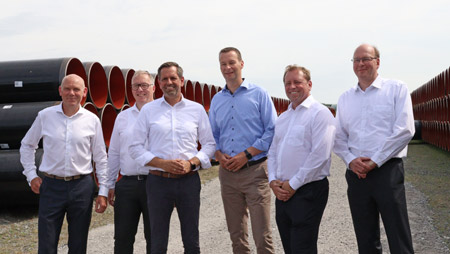
At the beginning of August, Lower Saxony's Minister of Energy and Climate Protection Olaf Lies met with representatives of the companies involved in the pipeline project - including the transmission system operator OGE, the Friedrich Vorwerk Group, Mannesmann Grossrohr GmbH and Max Streicher GmbH - for the official start of gas pipeline construction. What would otherwise take eight years under German planning law is to be completed in just eight months.

LNG terminal in Wilhelmshaven: pipeline half
complete
Source: NDR Niedersachsen / ARD Mediathek
LNG-Terminal Wilhelmshaven: Pipeline construction started
Source: NDR Niedersachsen
Construction for Pipeline started for LNG-Terminal in Wilhelmshaven
Source: Sat.1 Regional
Plans presented for LNG-Terminal in Wilhelmshaven
Source: NDR Niedersachsen / ARD MediathekLNG-Terminal Brunsbüttel
Mannesmann Grossrohr GmbH supplies pipes to connect the Brunsbüttel LNG terminal.
MGR received an order from GASUNIE Germany to produce and supply the pipes for the Energy Transmission Line 180 (ETL 180) from Brunsbüttel to Hetlingen.
The pipeline with a diameter of DIN 800 has a length of approx. 54 km. The approximately 3,200 pipes are to be delivered by February 2023 and are specified so that hydrogen can also be transported through the pipeline in the future. As MGR is currently already producing the pipes for the Wilhelmshaven Connection Line (WAL) for the Wilhelmshaven LNG terminal, MGR has now also been commissioned to supply the pipes for the connection of the LNG terminal in Brunsbüttel. Comment by Mr. Burkhard Becker, Chief Financial Officer of SZAG and responsible for the Steel Processing Division:
"A secure gas supply is a basic prerequisite for the functioning of society and the economy. That is why the planned LNG terminals and pipelines are of elementary importance for Germany's future energy supply, especially now. With its steel and tubes products, the Salzgitter Group is making an important contribution to the development of an efficient infrastructure. This project is also a prominent example of this."
The construction of the pipeline in the short term serves to further diversify the sources of gas supply quickly and is therefore of overriding importance in terms of energy policy.
The pipeline is scheduled to be commissioned by the end of 2023, enabling the volumes of the floating LNG terminal stationed in Brunsbüttel to be transported to the main points of consumption.
With an annual regasification capacity of 7.5 to 10 billion m³, it will create a further opportunity to procure natural gas from regions not previously connected to the German market by gas pipelines.